If you believe you are suffering from hearing loss, help is available in Los Angeles at American Hearing & Balance. If any of the following statements apply to you, it’s important to get your hearing checked by one of our staff.

  • When meeting someone for the first time, you are unable to hear them clearly.
  • You listen to the television or radio at a volume level which is uncomfortably loud for others in the room.
  • You frequently ask people you are speaking with to repeat themselves because it sounds as if they are mumbling or their speech is muffled.
  • You have frequent ringing in your ears that doesn’t go away.
  • You find it difficult to hear conversations in noisy places – such as restaurants, airports or parties.
  • You are unable to hear important sounds that occur during your day, including the alarm clock, cell phone notifications or the timer bell on the oven.
  • You have trouble hearing phone conversations, particularly cell phone conversations or phone calls with a great deal of background noise.
  • You feel as if your inability to hear is impairing your social life.
  • You find yourself trying to read lips.

If you are experiencing any of these warning signs, call or text American Hearing & Balance and make an appointment for a hearing test in Los Angeles.

What Does a Hearing Test Detect?

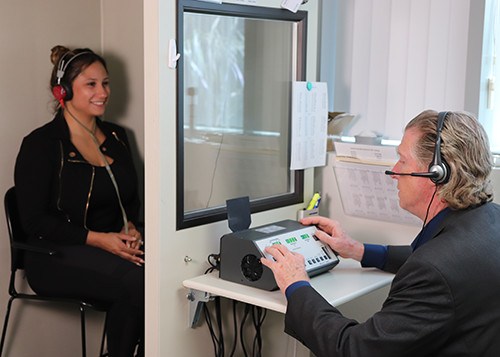
Keith Michaels, Au.D., administering a hearing test

A hearing test can detect issues as simple as an earwax obstruction, or as serious as permanent hearing loss. During your hearing test at American Hearing & Balance in Los Angeles, we will measure the threshold at which you are able to hear specific sounds by having you listen to a series of tones at different volumes. The hearing test will also measure how well you hear and understand speech. This may include testing to determine how well you hear speech when there is considerable background noise.

After the test is completed, your hearing aid professional will create an audiogram that shows your hearing sensitivity. Using frequencies measured in Hertz (Hz), and loudness measured in decibels, the audiogram measures the lowest volume levels at which you can hear certain sounds. The louder it takes for a sound to be heard, the greater the level of hearing loss.

We will review your hearing test results with you and determine your degree of hearing loss. Afterward, you can discuss potential treatment options and which hearing aids will work best for your situation.

How to Read Your Hearing Test Results

The normal range of hearing for a healthy adult is considered between 20 and 20,000 Hz. Most sounds we hear are between 250 and 6,000 Hz. A healthy adult should be able to hear sounds between 1 and 20 decibels at any frequency. Hearing loss of 25 decibels or less is considered typical hearing loss for an adult, and a hearing aid probably isn’t required.

Mild

Adults with hearing loss in the 26 to 40-decibel range are said to have mild hearing loss. Symptoms include difficulty understanding quiet conversations or difficulty hearing speech from across the room.

Moderate

Hearing loss in the 41 to 55-decibel range is defined as moderate hearing loss. Those with moderate hearing loss have difficulty hearing conversations at normal volume levels, and listening in noisy environments is extremely difficult.

Moderately Severe

If you have hearing loss in the 56 to 70-decibel range, it is considered moderately severe hearing loss. Symptoms include difficulty hearing quiet conversations or ringing telephones.

Severe

Severe hearing loss is defined as hearing loss that falls between 71 and 90 decibels. With severe hearing loss, you can only hear people who are standing next to you and speaking very loudly.

Profound

Hearing loss measured at 91 decibels and higher is considered profound hearing loss. These individuals are unable to hear loud speech or the everyday sounds around them.

If you suffer from any form of hearing loss, call or text American Hearing & Balance to set up an appointment and discuss treatment options.
Insurance Coverage & What to Expect at Your Visit 

Do we accept your insurance? 

Yes — American Hearing & Balance works with most major insurance plans, including: 

  • Medicare and Medicare Advantage plans (Humana, SCAN, Blue Shield of CA, Anthem Blue Cross, Health Net) 
  • Aetna HMO 
  • Cigna HMO 
  • United Healthcare HMO 
  • Blue Shield of CA HMO 
  • Anthem Blue Cross HMO and Vivity 
  • Health Net HMO 

Coverage for hearing evaluations varies by plan. Some insurance policies cover diagnostic hearing tests in full when referred by a physician; others may require a copay. We recommend calling our office before your visit — our team is experienced in verifying benefits and will let you know what to expect before you arrive. 

What does a hearing test appointment look like? 

Your visit at American Hearing & Balance typically takes 60 to 90 minutes. Here’s what happens: 

  1. Health and hearing history — We’ll ask about your symptoms, any noise exposure, medications (some are ototoxic), family history, and what’s been bothering you most. 
  1. Ear canal exam — A quick visual inspection to rule out earwax blockage or other physical factors before testing begins. 
  1. Diagnostic evaluation — Your audiologist will select the appropriate tests based on your concerns. Most adults receive pure-tone audiometry and speech testing at minimum. 
  1. Results walkthrough — Your audiogram is reviewed with you in plain language. We’ll explain exactly what your results mean, which sounds you’re missing, and in what environments that’s most likely to affect you. 
  1. Next steps — If hearing loss is found, we discuss options — from monitoring to hearing aids to physician referral — with no pressure. 

Family-owned for over 40 years, American Hearing & Balance has been serving the greater Los Angeles area across six locations. Our audiologists, including Dr. Keith Michaels, Au.D., bring decades of clinical experience to every evaluation. 

American Hearing & Balance

Reviewed by the board-certified ENTs doctors
at American Hearing & Balance

Still have questions? Ask one of our audiologists!